Introduction: SPUR, a Valuable Tool for Research

SPUR is a dynamic and predictive self-assessment questionnaire. Over the past 4 years, several tens of thousands of patients have tested SPUR, and our international research protocol validated the tool with the input of 2,500 patients globally. SPUR reliably detects a patient's risk of non-adherence and accurately articulates the reasons for his/her health behavior along four over-arching dimensions: Social, Psychological, Usage and Rational (the initials form the name SPUR).

SPUR is unique insofar as it allows researchers to:

  • Understand chronic patients’ behavior holistically,
  • Accurately detect the risk of non-adherence, even for naïve patients,
  • Limit bias through usage of Likert scale and non-judgmental question phrasing, and
  • Adapt suggestions for patient support.

Theoretical Frameworks behind SPUR

SPUR™ aggregates and distills decades of proven theories and models in behavioral science into a single validated digital tool. SPUR’s building blocks were informed by the following theories and models,

  • the Health Model Belief, established in the 1950s, which posits that a patient's beliefs in both the threat represented by the illness and the efficacy of the recommended treatment will determine his/her adherence to the recommended behavior,
  • the Theory of Planned Behavior, developed in the 1980s, which posits that behavior change requires active decision and planning, and that intentions to perform behaviors of different kinds can be predicted accurately from attitudes toward the behavior, subjective norms, and perceived behavioral control,
  • the COM-B model, developed in early 2000s, which identifies three factors that need to be present for any behavior to occur: capability, opportunity and motivation, and
  • the Transtheoretical Model of Change, developed in the 1970s, which lays out six stages of intentional change within health behavior change.

Various profiling approaches have built on the successes and addressed the shortcomings of their predecessors. One of the innovations of SPUR is its focus on the motivational dimension, through the evaluation of psychological drivers with demonstrated influence on adherence in chronic patients: rejection of identity as a patient, reactance and discounting of future benefits.

Health Behavior in Four Dimensions

Within the four over-arching dimensions of health behavior, SPUR calculates a score for 13 individual drivers:

These drivers relate to how patients behave according to their perceived role in society.

S1: IMMEDIATE - The degree to which a patient's beliefs about their role and social standing in their entourage are affected by their pathology.
S2: SOCIETAL - The degree to which a patient’s beliefs and attitudes about social norms and their potential impact on behavior are affected by their pathology.


These drivers relate to the psychological attitudes that impede patients’ ability to act on planned behavior.

P1: IDENTITY - The degree to which the idea of being a “patient” is traumatic, leading some to reject this identity.
P2: REACTANCE - The degree to which the patients has a negative responses to authority, namely the authority represented by their HCP.
P3: TIME - The degree to which a patient discounts future benefits.


These drivers relate to the patients' ability to access and follow treatment.

U1: SELF-EFFICACY - The degree to which the patient is capable, physically, or mentally, of following the treatment.
U2: FORGETFULNESS - The degree to which the patient will remember to take the treatment.
U3: AVAILABILITY - The degree to which the the patient will have trouble obtaining the treatment.
U4: FINANCIAL - The degree to which the the patient lacks the financial or practical resources to follow treatment.


These drivers refer to cognitive and educational elements impacting behavior or the capacity of the patient to project the benefits/risk balance of the treatment or disease on their life.

R1: DISEASE GRAVITY - The degree to which the patient underestimates the severity of the disease or its future complications.
R2: DISEASE SUSCEPTIBILITY - The degree to which the patient underestimates the danger of disease progression to them.
R3: TREATMENT BENEFIT - The degree to which the patient is convinced of the importance of the treatment.
R4: TREATMENT RISK - The degree to which the patient is concerned about obstacles to the treatment, such as side effects.


These drivers relate to how patients behave according to their perceived role in society.

S1: IMMEDIATE - The degree to which a patient's beliefs about their role and social standing in their entourage are affected by their pathology.
S2: SOCIETAL - The degree to which a patient’s beliefs and attitudes about social norms and their potential impact on behavior are affected by their pathology.


These drivers relate to the psychological attitudes that impede patients’ ability to act on planned behavior.

P1: IDENTITY - The degree to which the idea of being a “patient” is traumatic, leading some to reject this identity.
P2: REACTANCE - The degree to which the patients has a negative responses to authority, namely the authority represented by their HCP.
P3: TIME - The degree to which a patient discounts future benefits.


These drivers relate to the patients' ability to access and follow treatment.

U1: SELF-EFFICACY - The degree to which the patient is capable, physically, or mentally, of following the treatment.
U2: FORGETFULNESS - The degree to which the patient will remember to take the treatment.
U3: AVAILABILITY - The degree to which the the patient will have trouble obtaining the treatment.
U4: FINANCIAL - The degree to which the the patient lacks the financial or practical resources to follow treatment.


These drivers refer to cognitive and educational elements impacting behavior or the capacity of the patient to project the benefits/risk balance of the treatment or disease on their life.

R1: DISEASE GRAVITY - The degree to which the patient underestimates the severity of the disease or its future complications.
R2: DISEASE SUSCEPTIBILITY - The degree to which the patient underestimates the danger of disease progression to them.
R3: TREATMENT BENEFIT - The degree to which the patient is convinced of the importance of the treatment.
R4: TREATMENT RISK - The degree to which the patient is concerned about obstacles to the treatment, such as side effects.


History of SPUR's development

The development of SPUR started in 2015.  Kevin Dolgin, co-founder of Observia and longtime academic, was unable to find a tool that captured and measured the breadth of behavior of patients with chronic disease, especially in regard to adherence. Dolgin thus conducted a comprehensive literature review, inspired not only by medical literature, but also by psychology and behavioral economics. The result was a new theoretical framework of chronic patient health behavior.

Observia then developed a first version of SPUR, a diagnostic tool based on this theoretical framework. Several patient support programs leveraged this new tool between 2017 and 2020. See more on Observia, the sponsoring organization behind SPUR.

Concurrently, Dolgin and a Board of Experts, with the financial and administrative support of Observia and partners for data analysis, embarked on a comprehensive R&D program to refine the existing tool and scientifically validate a second version of SPUR. This team analyzed and adapted more than 100 existing health questionnaires to create a 45-item questionnaire. Fifty patients tested this questionnaire, in three languages and in four countries The team then reviewed the items for clarity and consistency, before more than 1000 type-2 diabetes patients tested the questionnaire in three patient studies in the United States, France and the United Kingdom.

Of the 45 items that originally came out of psychometric studies, all were used in various studies thereafter leading to the development of a dynamic tool that ranges from 6 to 24 questions. In an early research protocol in the UK, Joshua Wells found 27 items (using factor analysis) that were statistically significant. Later on, studies using advanced statistical methods, namely Rasch modeling, reduced the number to 24 items. In all cases of studies of items for SPUR, the four over-arching dimensions and 13 drivers are fundamentally the same. Therefore, we find that the Rasch modeling added further sophistication and proved the same underlying measurements as earlier, less refined, calculations.

The team developed a 24-question version of SPUR based on the extensive R&D. Analysis of the collected data validated the predictive power of SPUR and its ability to identify patients' behavioral drivers. The new version of the SPUR questionnaire adapts to the patient's responses, from 6 questions to a more detailed section of up to 24 questions. Three research papers have been published or are under review on the basis of this data. See publications here.

Board of experts

SPUR is the result of the collaboration of experts across the globe who contributed their expertise and efforts to build this tool. In 2018, we put together a board of experts in the field of health behavior and digital transformation. They help us ground our innovation in validated theories and assess it in real-life environments. 

  • Prof. John Piette - Professor Department of Health Behavior Health Education and Co-Director of the Center for Managing Chronic Disease, University of Michigan 
  • Marie-Eve Laporte - Associate Professor in Management Sciences, Paris IAE - Universite Paris 1 Panthéon-Sorbonne 
  • Prof. Lydiane Nabec - Professor in Management Sciences, Universite Paris-Sud / Paris-Saclay, France 
  • Prof. Reem Kayyali, Professor of Clinical and Applied Pharmacy Practice, Head of Pharmacy Department, Kingston University
  • Dr. Helen Mosnier-Pudar, Medical Doctor, Endocrinology & Diabetology Department, Cochin Hospital AP-HP
  • Prof. Emer. Gérard Reach, Paris 13 University, Quality and Patient Rights Department, Paris-Seine St-Denis University Hospitals AP-HP, Specialist in Patient Education
  • Pr. Anoop Chauhan - Consultant Respiratory Physician and Chief Research Officer at Portsmouth Hospitals University and Isle of Wight NHS Trusts.
  • Dr. Joshua Wells - Lead researcher at Kingston Hospital NHS Foundation Trust.

Published papers validating or citing SPUR - Free access to all publications

Our SPUR research plan, started in 2017, was divided in 3 phases:

  • Phase 0 aimed at the establishment of our model's academic foundations, through a literature review, a board review and the elaboration of a decision-making framework

  • Phase 1 had two objectives, identifying the questions to be included in SPUR and evaluating the psychometric properties of the questionnaire. This was done through a literature review, a board review and qualitative interviews with patients with diabetes, COPD, breast cancer and multiple sclerosis.

  • Phase 2's goals were to validate the final structure of the SPUR tool and validate the predictive power of the SPUR tool with real-life adherence data through MPR, via a mutli-country quantitative analysis in Type 2 Diabetes and a mutli-pathology approach.

The global outcomes of this research plan is that SPUR reliably detects a patient's risk of non-adherence and the drivers of their health behavior across cultures and pathologies.

Date
Description

Citation and link to original article: Dolgin, K., Kayyali, R., Wells, J. et al. Predicting and understanding non-adherence in chronic disease: cross-cohort validation and structural equation modeling of the SPUR 6/24 tool. Sci Rep 15, 33216 (2025). https://doi.org/10.1038/s41598-025-17866-6

Introduction: The SPUR PRAM (Patient-Reported Adherence Measure) was developed over 2021 and 2022 via a series of studies in Europe and the United States. These studies collectively demonstrate the potential of SPUR to help assess non-adherence risk for patients with chronic disease via an interactive, digital tool that further identifies the specific drivers of that risk (13 drivers categorized into 4 main dimensions). 

After four years of study and development, sufficient data has been collected to permit analysis of pooled data of several cohorts, across three countries and four pathologies. This analysis allows the current, revised version of the tool to be applied to earlier cohorts which were assessed using previous versions as well as to the pooled data to further test the validity of the tool’s ability to identify non-adherence risk. The larger pooled data set also permits the use of structural equation modeling (SEM) to provide deeper insights into the interplay between the different behavioral drivers. This paper discusses the results of these analyses across five cohorts of patients.

Objective: The aim of this meta-analysis is to retroactively assess the validity of SPUR 6/24 on all the cohorts previously studied.

Conclusion: The validity of SPUR 6/24 both to determine the risk of non-adherence and the relative importance of the drivers behind that risk for each patient is reinforced, both in comparison to preceding versions of the tool and via its ability to provide robust results across heterogeneous patient cohorts.


Citation and link to original article

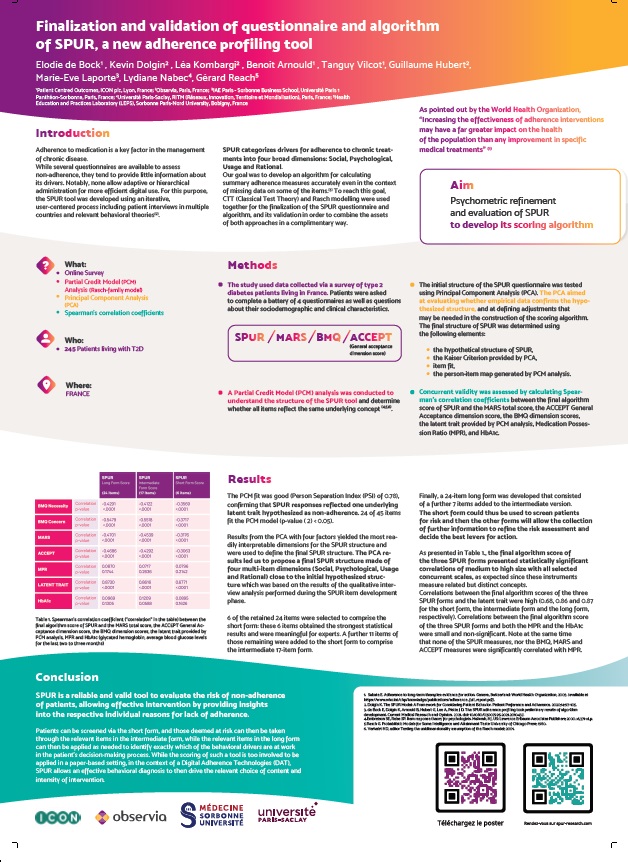
  • de Bock E, Dolgin K, Kombargi L, Arnould B, Vilcot T, Hubert G, Laporte ME, Nabec L, Reach G. Finalization and Validation of Questionnaire and Algorithm of SPUR, a New Adherence Profiling Tool. Patient Prefer Adherence. 2022;16:1213-1231
    https://doi.org/10.2147/PPA.S354705

Objective: The SPUR (Social, Psychological, Usage and Rational) Adherence Profiling Tool is a recently developed adaptive instrument for assessing key patient-level drivers for non-adherence. This study describes the SPUR questionnaire’s finalization and psychometric evaluation.

Conclusion: SPUR is a valid tool to evaluate the risk of non-adherence of patients, allowing effective intervention by providing insights into the respective individual reasons for lack of adherence.


Learn more about the refinement and validation of the SPUR questionnaire and algorithm


Finalization and validation of the SPUR questionnaire and algorithm


Citation and link to original article

  • Wells JSEl Husseini AOkoh S, et al. SPUR: psychometric properties of a patient-reported outcome measure of medication adherence in type 2 diabetes. 

Objective: This study aims to examine SPUR, a multifactorial measure of medication adherence reported by patients with type 2 diabetes, with a view to developing a suitable model for psychometric analysis. The study also aims to explore the relationship between the SPUR model and socio-clinical factors of medication adherence.

Conclusions: SPUR-27 demonstrated strong psychometric properties. Further work should look to examine the test–retest reliability of the model as well as examine transferability to other chronic conditions and broader population samples. Overall, the initial findings suggest that SPUR-27 is a reliable model for the multifactorial assessment of medication adherence among patients living with type 2 diabetes.


Citation and link to original article

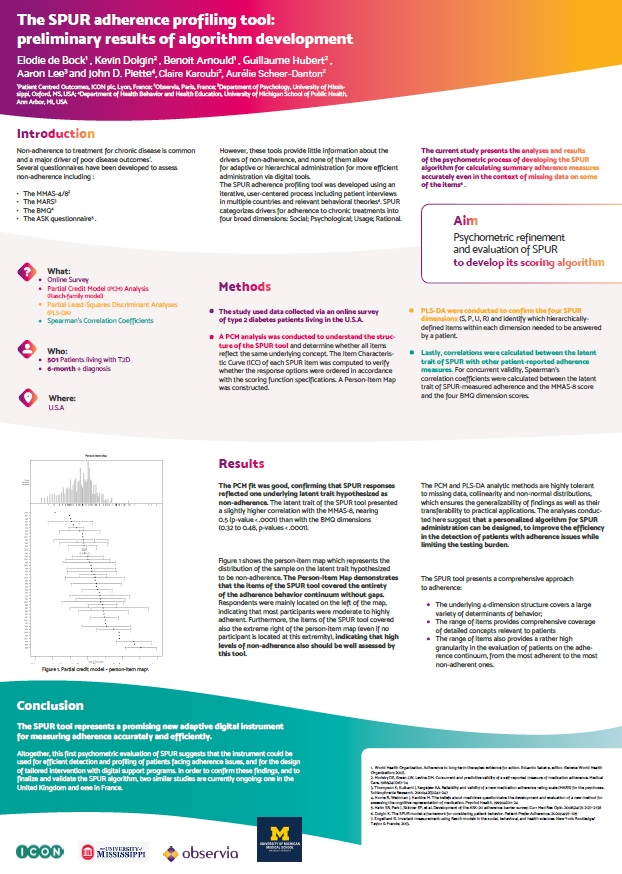
  • Elodie de Bock, Kevin Dolgin, Benoit Arnould, Guillaume Hubert, Aaron Lee & John D. Piette (2022). The SPUR adherence profiling tool: preliminary results of algorithm development, Current Medical Research and Opinion, 38:2, 171-179, DOI: 10.1080/03007995.2021.2010437

Objective: The SPUR (Social, Psychological, Usage, and Rational) Adherence Profiling Tool is a recently developed adaptive instrument for measuring key patient-level risk factors for adherence problems. This study describes the SPUR questionnaire’s psychometric refinement and evaluation.

Conclusions: The SPUR tool represents a promising new adaptive instrument for measuring adherence accurately and efficiently using the digital behavioral diagnostic tool.


Discover the validation results of SPUR in English on a population of patients with type 2 diabetes in the USA


 Poster of SPUR validation in T2D patients in USA


Citation and link to original article

  • J Wells, A El-Husseini, A Jaffar, K Dolgin, G Hubert, R Kayyali, A cross-sectional study to evaluate the validity of a novel patient-reported outcome measure of medication adherence in Type 2 Diabetes, International Journal of Pharmacy Practice, Volume 29, Issue Supplement_1, April 2021, Page i30, https://doi.org/10.1093/ijpp/riab015.036

Objective: TThe aim of this study is to compare the validity of SPUR with that of other previously validated PROMs (Patient-Reported Outcomes Measures) in patients with type 2 diabetes.

Conclusion: SPUR has demonstrated its validity against reference PROMs, while predicting adherence levels without exaggeration, which is often attributed to crude objective measures such as MPR (Medication Possession Ratio).


Citation and link to original article

  • Tugaut, B., Shah, S., Dolgin, K. et al. Development of the SPUR tool: a profiling instrument for patient treatment behavior. J Patient Rep Outcomes 6, 61 (2022). https://doi.org/10.1186/s41687-022-00470-x 

Objective: To develop a new tool assessing a comprehensive set of characteristics predictive of patient adherence to treatment, based on social, psychological, usage and rational (SPUR) behaviors. Existing self-assessment tools were identified through a targeted literature review, and cognitive tests were conducted during interviews with culturally diverse patient populations suffering from different chronic pathologies.

Conclusion: Our qualitative analyses indicated that the pilot SPUR tool is a promising model that may help clinicians and health systems to predict patient treatment behavior. Further steps using quantitative methods are needed to confirm its predictive validity and other psychometric properties.


Citation and link to original article

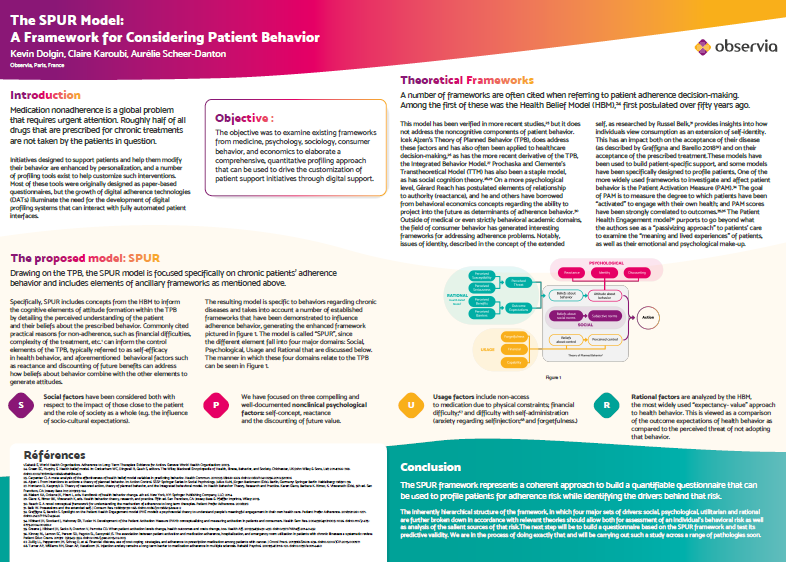
Objective: The objective of this study is to examine existing frameworks from medicine, psychology, sociology, consumer behavior, and economics to elaborate a comprehensive, quantitative profiling approach that can be used to drive the customization of patient support initiatives.

Conclusion: An interactive, digital questionnaire built around SPUR represents a potentially useful tool for those desirous of building interactive digital support programs for patients with chronic diseases.


Discover how the SPUR model integrates behavioral science theories applied to healthcare in an hollistic approach


The SPUR model integrates behavioral science theories applied to healthcare in an hollistic approach


Citation and link to original article: Dolgin, K., Kayyali, R., Wells, J. et al. Predicting and understanding non-adherence in chronic disease: cross-cohort validation and structural equation modeling of the SPUR 6/24 tool. Sci Rep 15, 33216 (2025). https://doi.org/10.1038/s41598-025-17866-6

Introduction: The SPUR PRAM (Patient-Reported Adherence Measure) was developed over 2021 and 2022 via a series of studies in Europe and the United States. These studies collectively demonstrate the potential of SPUR to help assess non-adherence risk for patients with chronic disease via an interactive, digital tool that further identifies the specific drivers of that risk (13 drivers categorized into 4 main dimensions). 

After four years of study and development, sufficient data has been collected to permit analysis of pooled data of several cohorts, across three countries and four pathologies. This analysis allows the current, revised version of the tool to be applied to earlier cohorts which were assessed using previous versions as well as to the pooled data to further test the validity of the tool’s ability to identify non-adherence risk. The larger pooled data set also permits the use of structural equation modeling (SEM) to provide deeper insights into the interplay between the different behavioral drivers. This paper discusses the results of these analyses across five cohorts of patients.

Objective: The aim of this meta-analysis is to retroactively assess the validity of SPUR 6/24 on all the cohorts previously studied.

Conclusion: The validity of SPUR 6/24 both to determine the risk of non-adherence and the relative importance of the drivers behind that risk for each patient is reinforced, both in comparison to preceding versions of the tool and via its ability to provide robust results across heterogeneous patient cohorts.


Citation and link to original article

  • de Bock E, Dolgin K, Kombargi L, Arnould B, Vilcot T, Hubert G, Laporte ME, Nabec L, Reach G. Finalization and Validation of Questionnaire and Algorithm of SPUR, a New Adherence Profiling Tool. Patient Prefer Adherence. 2022;16:1213-1231
    https://doi.org/10.2147/PPA.S354705

Objective: The SPUR (Social, Psychological, Usage and Rational) Adherence Profiling Tool is a recently developed adaptive instrument for assessing key patient-level drivers for non-adherence. This study describes the SPUR questionnaire’s finalization and psychometric evaluation.

Conclusion: SPUR is a valid tool to evaluate the risk of non-adherence of patients, allowing effective intervention by providing insights into the respective individual reasons for lack of adherence.


Learn more about the refinement and validation of the SPUR questionnaire and algorithm


Finalization and validation of the SPUR questionnaire and algorithm


Citation and link to original article

  • Wells JSEl Husseini AOkoh S, et al. SPUR: psychometric properties of a patient-reported outcome measure of medication adherence in type 2 diabetes. 

Objective: This study aims to examine SPUR, a multifactorial measure of medication adherence reported by patients with type 2 diabetes, with a view to developing a suitable model for psychometric analysis. The study also aims to explore the relationship between the SPUR model and socio-clinical factors of medication adherence.

Conclusions: SPUR-27 demonstrated strong psychometric properties. Further work should look to examine the test–retest reliability of the model as well as examine transferability to other chronic conditions and broader population samples. Overall, the initial findings suggest that SPUR-27 is a reliable model for the multifactorial assessment of medication adherence among patients living with type 2 diabetes.


Citation and link to original article

  • Elodie de Bock, Kevin Dolgin, Benoit Arnould, Guillaume Hubert, Aaron Lee & John D. Piette (2022). The SPUR adherence profiling tool: preliminary results of algorithm development, Current Medical Research and Opinion, 38:2, 171-179, DOI: 10.1080/03007995.2021.2010437

Objective: The SPUR (Social, Psychological, Usage, and Rational) Adherence Profiling Tool is a recently developed adaptive instrument for measuring key patient-level risk factors for adherence problems. This study describes the SPUR questionnaire’s psychometric refinement and evaluation.

Conclusions: The SPUR tool represents a promising new adaptive instrument for measuring adherence accurately and efficiently using the digital behavioral diagnostic tool.


Discover the validation results of SPUR in English on a population of patients with type 2 diabetes in the USA


 Poster of SPUR validation in T2D patients in USA


Citation and link to original article

  • J Wells, A El-Husseini, A Jaffar, K Dolgin, G Hubert, R Kayyali, A cross-sectional study to evaluate the validity of a novel patient-reported outcome measure of medication adherence in Type 2 Diabetes, International Journal of Pharmacy Practice, Volume 29, Issue Supplement_1, April 2021, Page i30, https://doi.org/10.1093/ijpp/riab015.036

Objective: TThe aim of this study is to compare the validity of SPUR with that of other previously validated PROMs (Patient-Reported Outcomes Measures) in patients with type 2 diabetes.

Conclusion: SPUR has demonstrated its validity against reference PROMs, while predicting adherence levels without exaggeration, which is often attributed to crude objective measures such as MPR (Medication Possession Ratio).


Citation and link to original article

  • Tugaut, B., Shah, S., Dolgin, K. et al. Development of the SPUR tool: a profiling instrument for patient treatment behavior. J Patient Rep Outcomes 6, 61 (2022). https://doi.org/10.1186/s41687-022-00470-x 

Objective: To develop a new tool assessing a comprehensive set of characteristics predictive of patient adherence to treatment, based on social, psychological, usage and rational (SPUR) behaviors. Existing self-assessment tools were identified through a targeted literature review, and cognitive tests were conducted during interviews with culturally diverse patient populations suffering from different chronic pathologies.

Conclusion: Our qualitative analyses indicated that the pilot SPUR tool is a promising model that may help clinicians and health systems to predict patient treatment behavior. Further steps using quantitative methods are needed to confirm its predictive validity and other psychometric properties.


Citation and link to original article

Objective: The objective of this study is to examine existing frameworks from medicine, psychology, sociology, consumer behavior, and economics to elaborate a comprehensive, quantitative profiling approach that can be used to drive the customization of patient support initiatives.

Conclusion: An interactive, digital questionnaire built around SPUR represents a potentially useful tool for those desirous of building interactive digital support programs for patients with chronic diseases.


Discover how the SPUR model integrates behavioral science theories applied to healthcare in an hollistic approach


The SPUR model integrates behavioral science theories applied to healthcare in an hollistic approach