
Validation
- Details
- Written by: Super User
- Category: SPUR
- Hits: 3208
Citation and link to original article
- de Bock E, Dolgin K, Kombargi L, Arnould B, Vilcot T, Hubert G, Laporte ME, Nabec L, Reach G. Finalization and Validation of Questionnaire and Algorithm of SPUR, a New Adherence Profiling Tool. Patient Prefer Adherence. 2022;16:1213-1231
https://doi.org/10.2147/PPA.S354705
Purpose: The SPUR (Social, Psychological, Usage and Rational) Adherence Profiling Tool is a recently developed adaptive instrument for assessing key patient-level drivers for non-adherence. This study describes the SPUR questionnaire’s finalization and psychometric evaluation.
Patients and Methods: Data were collected through an online survey among patients with type 2 diabetes included by general practitioners and diabetologists in France. The survey included four questionnaires, SPUR and three validated adherence measures: BMQ, MARS and ACCEPT. Item-level analysis and a partial credit model (PCM) were performed to refine the response option coding of SPUR items. The final item selection of SPUR was defined using a PCM and a principal component analysis (PCA). Construct validity, concurrent validity and known-groups validity were assessed on the final SPUR questionnaire.
Results: A total of 245 patients (55% men, mean age of 63 years) completed the survey remotely and were included in this analysis. Refining response option coding allowed a better discrimination of patients on the latent trait. After item selection, a short, an intermediate, and a long form composed the final SPUR questionnaire. The short form will be used to screen patients for risk and then the other forms will allow the collection of further information to refine the risk assessment and decide the best levers for action. Results obtained were supportive of the construct validity of the forms. Their concurrent validity was demonstrated: moderate to high significant correlations were obtained with BMQ, MARS and ACCEPT scores. Their known-groups validity were shown with a logical pattern of higher scores obtained for patients considered non-adherent and significant differences between the scores obtained for patients considered adherent versus non-adherent.
Conclusion: SPUR is a valid tool to evaluate the risk of non-adherence of patients, allowing effective intervention by providing insights into the respective individual reasons for lack of adherence.
Download SPUR poster - Phase 2, French Study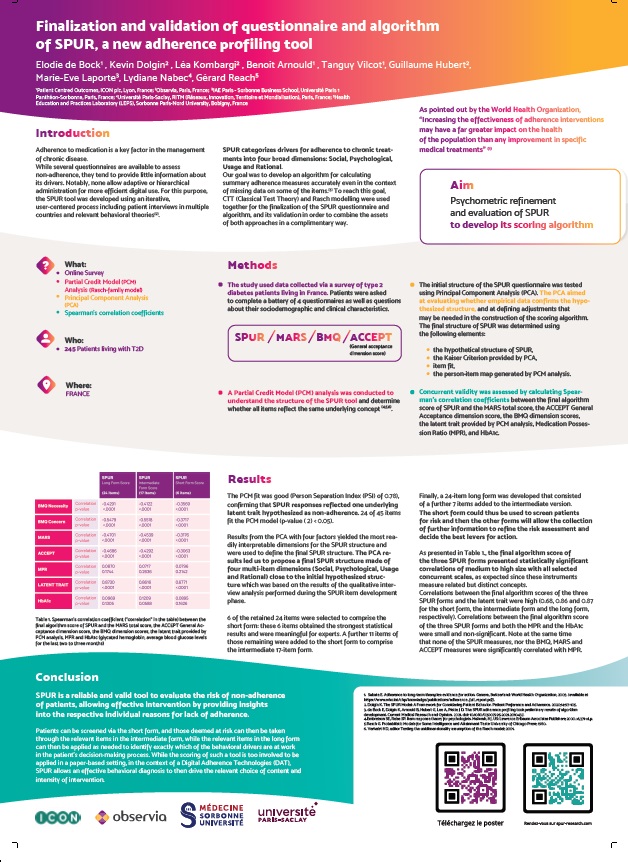
We are processing this data per your request only. We are hosting the data internally. We will not share it. This information will be used to send you information from the author's team, and you will not subscribed to any newsletters other marketing materials. We store the data for maximum of 3 years on secure servers. You can find out how to send a request to access your data, request to delete your data, correct any inaccuracies or restrict our processing of your data. You have the right to lodge a complaint about the way we handle your data with French Data Protection authority CNIL or you can contact our DPO at
Citation and link to original article
Introduction: Poor medication adherence is associated with worsening patient health outcomes and increasing healthcare costs. A holistic tool to assess both medication adherence and drivers of adherence behaviour has yet to be developed. This study aimed to examine SPUR, a multifactorial patient-reported outcome measure of medication adherence in patients living with type 2 diabetes, with a view to develop a suitable model for psychometric analysis.
Furthermore, the study aimed to explore the relationship between the SPUR model and socio-clinical factors of medication adherence.
Research design and methods: The study recruited 378 adult patients living with type 2 diabetes from a mix of community and secondary-care settings to participate in this non-interventional cross-sectional study. The original SPUR-45 tool was completed by participants with other patient-reported outcome measures for comparison, in addition to the collection of two objective adherence measures; HbA1c and the medication possession ratio (MPR).
Results: Factor and reliability analysis conducted on SPUR-45 produced a revised and more concise version (27-items) of the tool, SPUR-27, which was psychometrically assessed. SPUR-27 observed strong internal consistency with significant correlations to the other psychometric measures (Beliefs about Medication Questionnaire, Diabetes Treatment Satisfaction Questionnaire, Medicine Adherence Rating Scale) completed by participants. Higher SPUR-27 scores were associated with lower HbA1c values and a higher MPR, as well as other predicted socio-clinical factors such as higher income, increased age and lower body mass index.
Conclusions: SPUR-27 demonstrated strong psychometric properties. Further work should look to examine the test–retest reliability of the model as well as examine transferability to other chronic conditions and broader population samples. Overall, the initial findings suggest that SPUR-27 is a reliable model for the multifactorial assessment of medication adherence among patients living with type 2 diabetes.
Citation and link to original article
- Elodie de Bock, Kevin Dolgin, Benoit Arnould, Guillaume Hubert, Aaron Lee & John D. Piette (2022). The SPUR adherence profiling tool: preliminary results of algorithm development, Current Medical Research and Opinion, 38:2, 171-179, DOI: 10.1080/03007995.2021.2010437
Objective: The SPUR (Social, Psychological, Usage, and Rational) Adherence Profiling Tool is a recently developed adaptive instrument for measuring key patient-level risk factors for adherence problems. This study describes the SPUR questionnaire’s psychometric refinement and evaluation.
Methods: Data were collected through an online survey among individuals with type 2 diabetes in the United States. 501 participants completed multiple questionnaires, including SPUR and several validated adherence measures. A Partial Credit Model (PCM) analysis was performed to evaluate the structure of the SPUR tool and verify the assumption of a single underlying latent variable reflecting adherence. Partial least-squares discriminant analyses (PLS-DA) were conducted to identify which hierarchically-defined items within each dimension needed to be answered by a given patient. Lastly, correlations were calculated between the latent trait of SPUR adherence and other patient-reported adherence measures.
Results: Of the 45 candidate SPUR items, 39 proved to fit well to the PCM confirming that SPUR responses reflected one underlying latent trait hypothesized as non-adherence. Correlations between the latent trait of the SPUR tool and other adherence measures were positive, statistically significant, and ranged from 0.32 to 0.48 (p-values < .0001). The person-item map showed that the items reflected well the range of adherence behaviors from perfect adherence to high levels of non-adherence. The PLS-DA results confirmed the relevance of using four meta-items as filters to open or close subsequent items from their corresponding SPUR dimensions.
Conclusions: The SPUR tool represents a promising new adaptive instrument for measuring adherence accurately and efficiently using the digital behavioral diagnostic tool.
Download SPUR poster - phase 2, US Study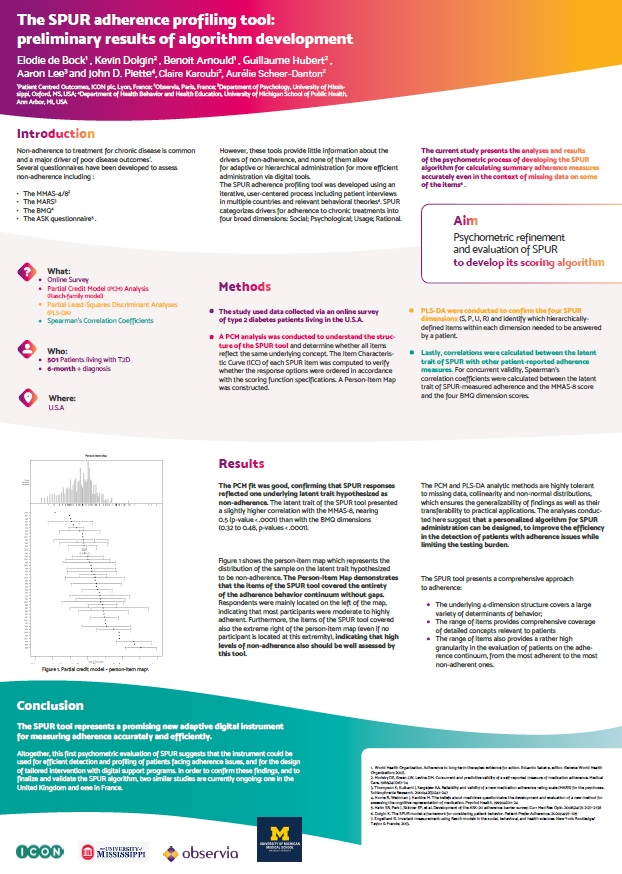
We are processing this data per your request only. We are hosting the data internally. We will not share it. This information will be used to send you information from the author's team, and you will not subscribed to any newsletters other marketing materials. We store the data for maximum of 3 years on secure servers. You can find out how to send a request to access your data, request to delete your data, correct any inaccuracies or restrict our processing of your data. You have the right to lodge a complaint about the way we handle your data with French Data Protection authority CNIL or you can contact our DPO at
Citation and link to original article
- J Wells, A El-Husseini, A Jaffar, K Dolgin, G Hubert, R Kayyali, A cross-sectional study to evaluate the validity of a novel patient-reported outcome measure of medication adherence in Type 2 Diabetes, International Journal of Pharmacy Practice, Volume 29, Issue Supplement_1, April 2021, Page i30, https://doi.org/10.1093/ijpp/riab015.036
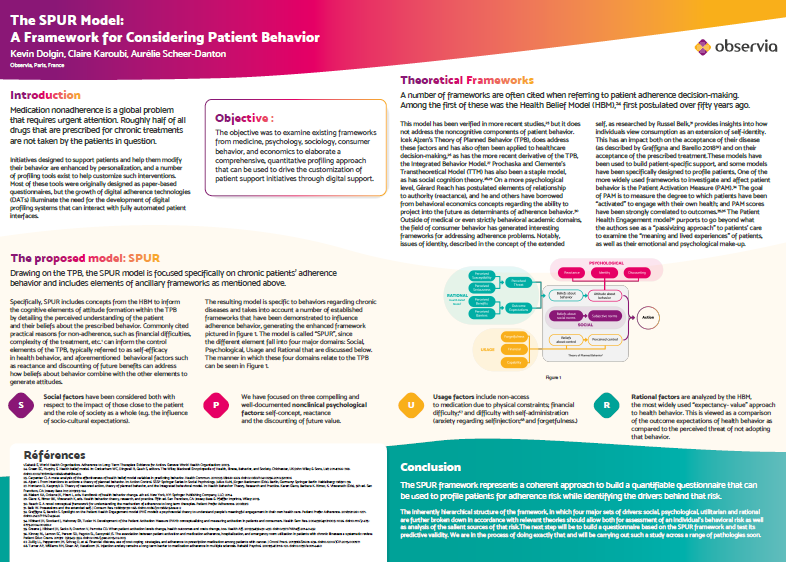
Background: Medication nonadherence is a global problem that requires urgent attention. Roughly half of all drugs that are prescribed for chronic treatments are not taken by the patients in question. Initiatives designed to support patients and help them modify their behavior are enhanced by personalization, and a number of profiling tools exist to help customize such interventions. Most of these tools were originally designed as paper-based questionnaires, but the growth of digital adherence technologies (DATs) illuminate the need for the development of digital profiling systems that can interact with fully automated patient interfaces.
Objective: The objective of this study was to examine existing frameworks from medicine, psychology, sociology, consumer behavior, and economics to elaborate a comprehensive, quantitative profiling approach that can be used to drive the customization of patient support initiatives.
Results: Building primarily on Icek Ajzen’s Theory of Planned Behavior (TPB), the Health Belief Model (HBM) was used to inform the beliefs about behavior posited in the TPB, while incorporating established factors regarding self-efficacy in the “control” elements of the TPB and selected social and psychological factors in the other constituents of the model. The resulting SPUR (Social, Psychological, Usage, Rational) framework represents a holistic, profiling tool with detailed, quantitative outputs that describe a patient’s behavioral risks and the drivers of that risk.
Conclusion: An interactive, digital questionnaire built around SPUR represents a potentially useful tool for those desirous of building interactive digital support programs for patients with chronic diseases.
Citation and link to original article
- Tugaut, B., Shah, S., Dolgin, K. et al. Development of the SPUR tool: a profiling instrument for patient treatment behavior. J Patient Rep Outcomes 6, 61 (2022). https://doi.org/10.1186/s41687-022-00470-x
Background: Long-term treatment adherence is a worldwide concern, with nonadherence resulting from a complex interplay of behaviors and health beliefs. Determining an individual’s risk of nonadherence and identifying the drivers of that risk are crucial for the development of successful interventions for improving adherence. Here, we describe the development of a new tool assessing a comprehensive set of characteristics predictive of patients’ treatment adherence based on the Social, Psychological, Usage and Rational (SPUR) adherence framework. Concepts from existing self-reporting tools of adherence-related behaviors were identified following a targeted MEDLINE literature review and a subset of these concepts were then selected for inclusion in the new tool. SPUR tool items, simultaneously generated in US English and in French, were tested iteratively through two rounds of cognitive interviews with US and French patients taking long-term treatments for chronic diseases. The pilot SPUR tool, resulting from the qualitative analysis of patients’ responses, was then adapted to other cultural settings (China and the UK) and subjected to further rounds of cognitive testing.
Results: The literature review identified 27 relevant instruments, from which 49 concepts were included in the SPUR tool (Social: 6, Psychological: 13, Usage: 11, Rational: 19). Feedback from US and French patients suffering from diabetes, multiple sclerosis, or breast cancer (n = 14 for the first round; n = 16 for the second round) indicated that the SPUR tool was well accepted and consistently understood. Minor modifications were implemented, resulting in the retention of 45 items (Social: 5, Psychological: 14, Usage: 10, Rational: 16). Results from the cognitive interviews conducted in China (15 patients per round suffering from diabetes, breast cancer or chronic obstructive pulmonary disease) and the UK (15 patients suffering from diabetes) confirmed the validity of the tool content, with no notable differences being identified across countries or chronic conditions.
Conclusion: Our qualitative analyses indicated that the pilot SPUR tool is a promising model that may help clinicians and health systems to predict patient treatment behavior. Further steps using quantitative methods are needed to confirm its predictive validity and other psychometric properties.
Citation and link to original article
- Dolgin K. The SPUR Model: A Framework for Considering Patient Behavior. Patient Prefer Adherence. 2020;14:97-105
https://doi.org/10.2147/PPA.S237778
Background: Medication nonadherence is a global problem that requires urgent attention. Roughly half of all drugs that are prescribed for chronic treatments are not taken by the patients in question. Initiatives designed to support patients and help them modify their behavior are enhanced by personalization, and a number of profiling tools exist to help customize such interventions. Most of these tools were originally designed as paper-based questionnaires, but the growth of digital adherence technologies (DATs) illuminate the need for the development of digital profiling systems that can interact with fully automated patient interfaces.
Objective: The objective of this study was to examine existing frameworks from medicine, psychology, sociology, consumer behavior, and economics to elaborate a comprehensive, quantitative profiling approach that can be used to drive the customization of patient support initiatives.
Results: Building primarily on Icek Ajzen’s Theory of Planned Behavior (TPB), the Health Belief Model (HBM) was used to inform the beliefs about behavior posited in the TPB, while incorporating established factors regarding self-efficacy in the “control” elements of the TPB and selected social and psychological factors in the other constituents of the model. The resulting SPUR (Social, Psychological, Usage, Rational) framework represents a holistic, profiling tool with detailed, quantitative outputs that describe a patient’s behavioral risks and the drivers of that risk.
Conclusion: An interactive, digital questionnaire built around SPUR represents a potentially useful tool for those desirous of building interactive digital support programs for patients with chronic diseases.
Download SPUR poster - Phase 0
We are processing this data per your request only. We are hosting the data internally. We will not share it. This information will be used to send you information from the author's team, and you will not subscribed to any newsletters other marketing materials. We store the data for maximum of 3 years on secure servers. You can find out how to send a request to access your data, request to delete your data, correct any inaccuracies or restrict our processing of your data. You have the right to lodge a complaint about the way we handle your data with French Data Protection authority CNIL or you can contact our DPO at
Citation and link to original article
- de Bock E, Dolgin K, Kombargi L, Arnould B, Vilcot T, Hubert G, Laporte ME, Nabec L, Reach G. Finalization and Validation of Questionnaire and Algorithm of SPUR, a New Adherence Profiling Tool. Patient Prefer Adherence. 2022;16:1213-1231
https://doi.org/10.2147/PPA.S354705
Purpose: The SPUR (Social, Psychological, Usage and Rational) Adherence Profiling Tool is a recently developed adaptive instrument for assessing key patient-level drivers for non-adherence. This study describes the SPUR questionnaire’s finalization and psychometric evaluation.
Patients and Methods: Data were collected through an online survey among patients with type 2 diabetes included by general practitioners and diabetologists in France. The survey included four questionnaires, SPUR and three validated adherence measures: BMQ, MARS and ACCEPT. Item-level analysis and a partial credit model (PCM) were performed to refine the response option coding of SPUR items. The final item selection of SPUR was defined using a PCM and a principal component analysis (PCA). Construct validity, concurrent validity and known-groups validity were assessed on the final SPUR questionnaire.
Results: A total of 245 patients (55% men, mean age of 63 years) completed the survey remotely and were included in this analysis. Refining response option coding allowed a better discrimination of patients on the latent trait. After item selection, a short, an intermediate, and a long form composed the final SPUR questionnaire. The short form will be used to screen patients for risk and then the other forms will allow the collection of further information to refine the risk assessment and decide the best levers for action. Results obtained were supportive of the construct validity of the forms. Their concurrent validity was demonstrated: moderate to high significant correlations were obtained with BMQ, MARS and ACCEPT scores. Their known-groups validity were shown with a logical pattern of higher scores obtained for patients considered non-adherent and significant differences between the scores obtained for patients considered adherent versus non-adherent.
Conclusion: SPUR is a valid tool to evaluate the risk of non-adherence of patients, allowing effective intervention by providing insights into the respective individual reasons for lack of adherence.
Download SPUR poster - Phase 2, French Study
We are processing this data per your request only. We are hosting the data internally. We will not share it. This information will be used to send you information from the author's team, and you will not subscribed to any newsletters other marketing materials. We store the data for maximum of 3 years on secure servers. You can find out how to send a request to access your data, request to delete your data, correct any inaccuracies or restrict our processing of your data. You have the right to lodge a complaint about the way we handle your data with French Data Protection authority CNIL or you can contact our DPO at
Citation and link to original article
Introduction: Poor medication adherence is associated with worsening patient health outcomes and increasing healthcare costs. A holistic tool to assess both medication adherence and drivers of adherence behaviour has yet to be developed. This study aimed to examine SPUR, a multifactorial patient-reported outcome measure of medication adherence in patients living with type 2 diabetes, with a view to develop a suitable model for psychometric analysis.
Furthermore, the study aimed to explore the relationship between the SPUR model and socio-clinical factors of medication adherence.
Research design and methods: The study recruited 378 adult patients living with type 2 diabetes from a mix of community and secondary-care settings to participate in this non-interventional cross-sectional study. The original SPUR-45 tool was completed by participants with other patient-reported outcome measures for comparison, in addition to the collection of two objective adherence measures; HbA1c and the medication possession ratio (MPR).
Results: Factor and reliability analysis conducted on SPUR-45 produced a revised and more concise version (27-items) of the tool, SPUR-27, which was psychometrically assessed. SPUR-27 observed strong internal consistency with significant correlations to the other psychometric measures (Beliefs about Medication Questionnaire, Diabetes Treatment Satisfaction Questionnaire, Medicine Adherence Rating Scale) completed by participants. Higher SPUR-27 scores were associated with lower HbA1c values and a higher MPR, as well as other predicted socio-clinical factors such as higher income, increased age and lower body mass index.
Conclusions: SPUR-27 demonstrated strong psychometric properties. Further work should look to examine the test–retest reliability of the model as well as examine transferability to other chronic conditions and broader population samples. Overall, the initial findings suggest that SPUR-27 is a reliable model for the multifactorial assessment of medication adherence among patients living with type 2 diabetes.
Citation and link to original article
- Elodie de Bock, Kevin Dolgin, Benoit Arnould, Guillaume Hubert, Aaron Lee & John D. Piette (2022). The SPUR adherence profiling tool: preliminary results of algorithm development, Current Medical Research and Opinion, 38:2, 171-179, DOI: 10.1080/03007995.2021.2010437
Objective: The SPUR (Social, Psychological, Usage, and Rational) Adherence Profiling Tool is a recently developed adaptive instrument for measuring key patient-level risk factors for adherence problems. This study describes the SPUR questionnaire’s psychometric refinement and evaluation.
Methods: Data were collected through an online survey among individuals with type 2 diabetes in the United States. 501 participants completed multiple questionnaires, including SPUR and several validated adherence measures. A Partial Credit Model (PCM) analysis was performed to evaluate the structure of the SPUR tool and verify the assumption of a single underlying latent variable reflecting adherence. Partial least-squares discriminant analyses (PLS-DA) were conducted to identify which hierarchically-defined items within each dimension needed to be answered by a given patient. Lastly, correlations were calculated between the latent trait of SPUR adherence and other patient-reported adherence measures.
Results: Of the 45 candidate SPUR items, 39 proved to fit well to the PCM confirming that SPUR responses reflected one underlying latent trait hypothesized as non-adherence. Correlations between the latent trait of the SPUR tool and other adherence measures were positive, statistically significant, and ranged from 0.32 to 0.48 (p-values < .0001). The person-item map showed that the items reflected well the range of adherence behaviors from perfect adherence to high levels of non-adherence. The PLS-DA results confirmed the relevance of using four meta-items as filters to open or close subsequent items from their corresponding SPUR dimensions.
Conclusions: The SPUR tool represents a promising new adaptive instrument for measuring adherence accurately and efficiently using the digital behavioral diagnostic tool.
Download SPUR poster - phase 2, US Study
We are processing this data per your request only. We are hosting the data internally. We will not share it. This information will be used to send you information from the author's team, and you will not subscribed to any newsletters other marketing materials. We store the data for maximum of 3 years on secure servers. You can find out how to send a request to access your data, request to delete your data, correct any inaccuracies or restrict our processing of your data. You have the right to lodge a complaint about the way we handle your data with French Data Protection authority CNIL or you can contact our DPO at
Citation and link to original article
- J Wells, A El-Husseini, A Jaffar, K Dolgin, G Hubert, R Kayyali, A cross-sectional study to evaluate the validity of a novel patient-reported outcome measure of medication adherence in Type 2 Diabetes, International Journal of Pharmacy Practice, Volume 29, Issue Supplement_1, April 2021, Page i30, https://doi.org/10.1093/ijpp/riab015.036
Background: Medication nonadherence is a global problem that requires urgent attention. Roughly half of all drugs that are prescribed for chronic treatments are not taken by the patients in question. Initiatives designed to support patients and help them modify their behavior are enhanced by personalization, and a number of profiling tools exist to help customize such interventions. Most of these tools were originally designed as paper-based questionnaires, but the growth of digital adherence technologies (DATs) illuminate the need for the development of digital profiling systems that can interact with fully automated patient interfaces.
Objective: The objective of this study was to examine existing frameworks from medicine, psychology, sociology, consumer behavior, and economics to elaborate a comprehensive, quantitative profiling approach that can be used to drive the customization of patient support initiatives.
Results: Building primarily on Icek Ajzen’s Theory of Planned Behavior (TPB), the Health Belief Model (HBM) was used to inform the beliefs about behavior posited in the TPB, while incorporating established factors regarding self-efficacy in the “control” elements of the TPB and selected social and psychological factors in the other constituents of the model. The resulting SPUR (Social, Psychological, Usage, Rational) framework represents a holistic, profiling tool with detailed, quantitative outputs that describe a patient’s behavioral risks and the drivers of that risk.
Conclusion: An interactive, digital questionnaire built around SPUR represents a potentially useful tool for those desirous of building interactive digital support programs for patients with chronic diseases.
Citation and link to original article
- Tugaut, B., Shah, S., Dolgin, K. et al. Development of the SPUR tool: a profiling instrument for patient treatment behavior. J Patient Rep Outcomes 6, 61 (2022). https://doi.org/10.1186/s41687-022-00470-x
Background: Long-term treatment adherence is a worldwide concern, with nonadherence resulting from a complex interplay of behaviors and health beliefs. Determining an individual’s risk of nonadherence and identifying the drivers of that risk are crucial for the development of successful interventions for improving adherence. Here, we describe the development of a new tool assessing a comprehensive set of characteristics predictive of patients’ treatment adherence based on the Social, Psychological, Usage and Rational (SPUR) adherence framework. Concepts from existing self-reporting tools of adherence-related behaviors were identified following a targeted MEDLINE literature review and a subset of these concepts were then selected for inclusion in the new tool. SPUR tool items, simultaneously generated in US English and in French, were tested iteratively through two rounds of cognitive interviews with US and French patients taking long-term treatments for chronic diseases. The pilot SPUR tool, resulting from the qualitative analysis of patients’ responses, was then adapted to other cultural settings (China and the UK) and subjected to further rounds of cognitive testing.
Results: The literature review identified 27 relevant instruments, from which 49 concepts were included in the SPUR tool (Social: 6, Psychological: 13, Usage: 11, Rational: 19). Feedback from US and French patients suffering from diabetes, multiple sclerosis, or breast cancer (n = 14 for the first round; n = 16 for the second round) indicated that the SPUR tool was well accepted and consistently understood. Minor modifications were implemented, resulting in the retention of 45 items (Social: 5, Psychological: 14, Usage: 10, Rational: 16). Results from the cognitive interviews conducted in China (15 patients per round suffering from diabetes, breast cancer or chronic obstructive pulmonary disease) and the UK (15 patients suffering from diabetes) confirmed the validity of the tool content, with no notable differences being identified across countries or chronic conditions.
Conclusion: Our qualitative analyses indicated that the pilot SPUR tool is a promising model that may help clinicians and health systems to predict patient treatment behavior. Further steps using quantitative methods are needed to confirm its predictive validity and other psychometric properties.
Citation and link to original article
- Dolgin K. The SPUR Model: A Framework for Considering Patient Behavior. Patient Prefer Adherence. 2020;14:97-105
https://doi.org/10.2147/PPA.S237778
Background: Medication nonadherence is a global problem that requires urgent attention. Roughly half of all drugs that are prescribed for chronic treatments are not taken by the patients in question. Initiatives designed to support patients and help them modify their behavior are enhanced by personalization, and a number of profiling tools exist to help customize such interventions. Most of these tools were originally designed as paper-based questionnaires, but the growth of digital adherence technologies (DATs) illuminate the need for the development of digital profiling systems that can interact with fully automated patient interfaces.
Objective: The objective of this study was to examine existing frameworks from medicine, psychology, sociology, consumer behavior, and economics to elaborate a comprehensive, quantitative profiling approach that can be used to drive the customization of patient support initiatives.
Results: Building primarily on Icek Ajzen’s Theory of Planned Behavior (TPB), the Health Belief Model (HBM) was used to inform the beliefs about behavior posited in the TPB, while incorporating established factors regarding self-efficacy in the “control” elements of the TPB and selected social and psychological factors in the other constituents of the model. The resulting SPUR (Social, Psychological, Usage, Rational) framework represents a holistic, profiling tool with detailed, quantitative outputs that describe a patient’s behavioral risks and the drivers of that risk.
Conclusion: An interactive, digital questionnaire built around SPUR represents a potentially useful tool for those desirous of building interactive digital support programs for patients with chronic diseases.
Download SPUR poster - Phase 0
We are processing this data per your request only. We are hosting the data internally. We will not share it. This information will be used to send you information from the author's team, and you will not subscribed to any newsletters other marketing materials. We store the data for maximum of 3 years on secure servers. You can find out how to send a request to access your data, request to delete your data, correct any inaccuracies or restrict our processing of your data. You have the right to lodge a complaint about the way we handle your data with French Data Protection authority CNIL or you can contact our DPO at