Research studies

SPUR was developed as a novel PROM to better understand adherence and its drivers, valid across all chronic conditions and cultures. The SPUR adherence model and tool continue to be tested and proven in additional pathologies, geographies, and languages. Indeed, with SPUR, instead of having one point of data on non-adherence, through one questionnaire, a researcher can paint a picture of a population with 18 points of data.

SPUR is increasingly used in health economics (HEOR) to evaluate the long-term impact of adherence-improving interventions and to analyze correlations between its 18 adherence drivers and other factors, including social determinants of health (SDoH). 
Citation and link to original article

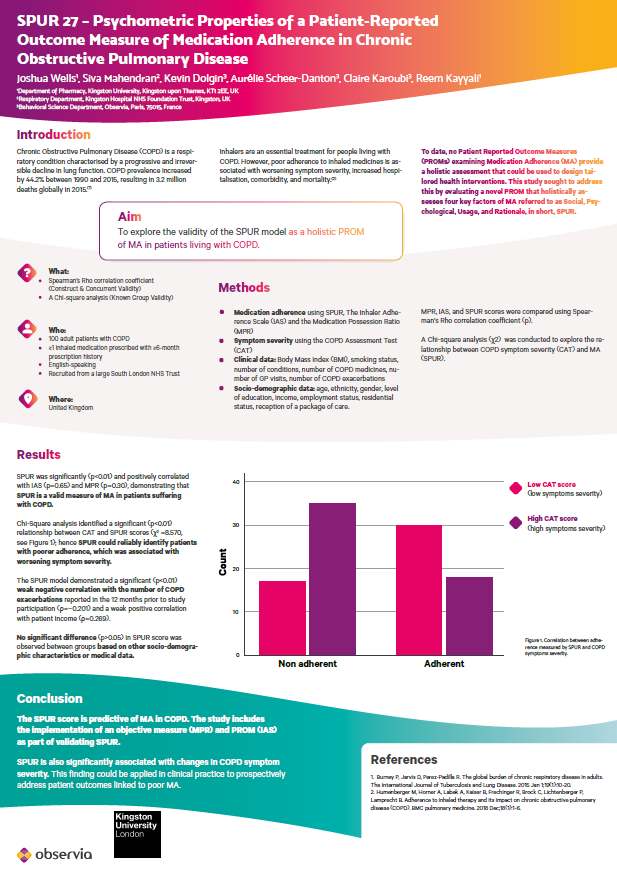
  • Joshua Wells, Siva Mahendran, Kevin Dolgin, Reem Kayyali. SPUR-27 – Psychometric Properties of a Patient- Reported Outcome Measure of Medication Adherence in Chronic Obstructive Pulmonary Disease. Patient Prefer Adherence. 2023 Feb 19;17:457-472.
  • https://doi.org/10.2147/ppa.s394538

Objective: The aim of this study is to evaluate the psychometric properties of the SPUR-27 model in COPD patients.

Conclusion: SPUR demonstrated strong psychometric properties in patients living with COPD. Further work should look to examine the test–retest reliability of the model and its application in broader sample populations.


Discover how SPUR predicts COPD patient compliance and symptom severity


Discover how SPUR predicts COPD patient compliance and symptom severity


Citation and link to original article

  • Joshua Wells, Siva Mahendran, Kevin Dolgin, Reem Kayyali. SPUR-27 – Psychometric Properties of a Patient- Reported Outcome Measure of Medication Adherence in Chronic Obstructive Pulmonary Disease. Patient Prefer Adherence. 2023 Feb 19;17:457-472.
  • https://doi.org/10.2147/ppa.s394538

Objective: The aim of this study is to evaluate the psychometric properties of the SPUR-27 model in COPD patients.

Conclusion: SPUR demonstrated strong psychometric properties in patients living with COPD. Further work should look to examine the test–retest reliability of the model and its application in broader sample populations.


Discover how SPUR predicts COPD patient compliance and symptom severity


Discover how SPUR predicts COPD patient compliance and symptom severity


Date
Description

Citation and link to original article

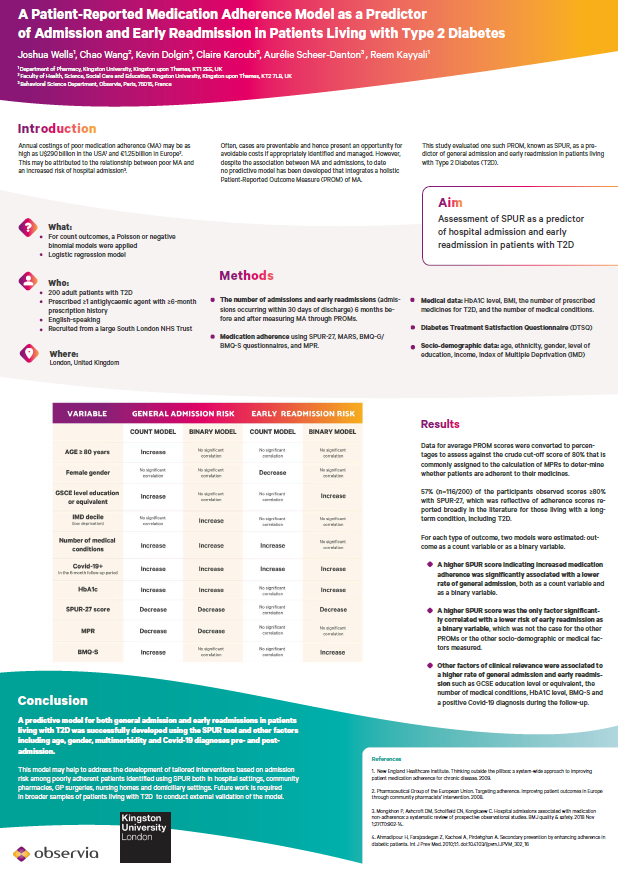
  • Wells J, Wang C, Dolgin K, Kayyali R. SPUR: A Patient-Reported Medication Adherence Model as a Predictor of Admission and Early Readmission in Patients Living with Type 2 Diabetes. Patient Prefer Adherence. 2023 Feb 19;17:441-455.
  • https://doi.org/10.2147/ppa.s397424

Objective: This study aims to assess whether SPUR can be used as a predictive indicator of hospitalization and early readmission in patients with type 2 diabetes.

Conclusion: Higher levels of medication adherence, as determined by SPUR, were significantly associated with a lower risk of general admissions and
early readmissions among patients living with Type 2 Diabetes. SPUR data could be used for early intervention to reduce the risk of hospitalization and the associated healthcare costs.


Learn more about SPUR and risk assessment for hospitalization and early readmission of T2D patients


SPUR and risk assessment for hospitalization and early readmission of T2D patients


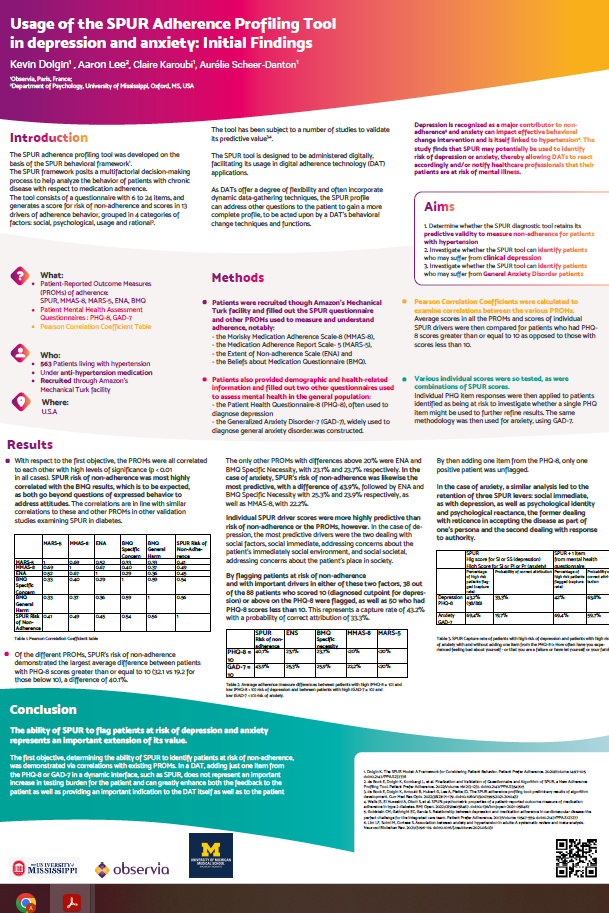
Citation and link to original article: to come

Objective: The aim of this study is to determine whether the SPUR diagnostic tool retains its predictive validity for measuring non-adherence in hypertensive patients, as well as its effectiveness in identifying those likely to suffer from clinical depression and generalized anxiety disorder.

Conclusion: SPUR's ability to identify patients at risk of non-adherence to hypertension treatment has been demonstrated through correlations with existing, validated PROMs. SPUR can also identify patients at risk of depression and anxiety, representing an important extension of its value, and could inform any healthcare professional with access to the patient profile of the need for a more comprehensive mental health diagnosis.


SPUR, hypertension and mental health: discover the results.


 SPUR, hypertension and mental health: discover the results.


Clinical development

Dropping out of a clinical trial is a health behavior. Patients who choose to stop participating in a trial always have reasons for doing so.

SPUR can examine patients’ social determinants of health, identify their risk factors to clinical study dropout and help personalize interventions to reduce non-adherence to protocol’s design. The tool also serves observational studies.

Medical practice

Healthcare professionals (HCPs) have deep patient insights, but time constraints and complex health behaviors can be challenging.

We developed SPUR4Care in which SPUR provides objective behavioral data and support recommendations that are directly actionable during medical appointment or health education sessions. It facilitates team discussions and help HCPs to adjust their wording in real-time for a better patient support and motivation.

For more information, contact us to learn more at hello@spur4care.com or visit www.spur4care.com (French only).

Market research

SPUR is a highly effective market research tool for pharmaceutical companies and other industrials. Integrated into Observia’s patient journey mapping methodologies, it enhances insights into patient attitudes and health behaviors.

Learn more on SPUR use case in patient journey mapping.

Patient experience

SPUR behavioral data supply the foundation for truly personalized, impactful, and patient-centric digital services. Industrials can develop tailored patient services to help chronic patient being engaged throughout their journey and cultivate the best habits to improve their quality of life.

Learn more on SPUR use cases for industrials.

Citation and link to original article

  • Wells J, Wang C, Dolgin K, Kayyali R. SPUR: A Patient-Reported Medication Adherence Model as a Predictor of Admission and Early Readmission in Patients Living with Type 2 Diabetes. Patient Prefer Adherence. 2023 Feb 19;17:441-455.
  • https://doi.org/10.2147/ppa.s397424

Objective: This study aims to assess whether SPUR can be used as a predictive indicator of hospitalization and early readmission in patients with type 2 diabetes.

Conclusion: Higher levels of medication adherence, as determined by SPUR, were significantly associated with a lower risk of general admissions and
early readmissions among patients living with Type 2 Diabetes. SPUR data could be used for early intervention to reduce the risk of hospitalization and the associated healthcare costs.


Learn more about SPUR and risk assessment for hospitalization and early readmission of T2D patients


SPUR and risk assessment for hospitalization and early readmission of T2D patients


Citation and link to original article: to come

Objective: The aim of this study is to determine whether the SPUR diagnostic tool retains its predictive validity for measuring non-adherence in hypertensive patients, as well as its effectiveness in identifying those likely to suffer from clinical depression and generalized anxiety disorder.

Conclusion: SPUR's ability to identify patients at risk of non-adherence to hypertension treatment has been demonstrated through correlations with existing, validated PROMs. SPUR can also identify patients at risk of depression and anxiety, representing an important extension of its value, and could inform any healthcare professional with access to the patient profile of the need for a more comprehensive mental health diagnosis.


SPUR, hypertension and mental health: discover the results.


 SPUR, hypertension and mental health: discover the results.